FOUNDATION GUIDE
Delivery-driver gear: what helps and what can wait
Build around the failures that interrupt your shift—not a shopping list assembled for somebody else.
A driver using a compact car for dinner deliveries does not have the same equipment problem as a grocery shopper loading an SUV or a courier working after dark. The useful question is not “What gear do drivers buy?” It is “What repeatedly fails during this kind of shift?”
Start with the four essential jobs
| Job | Failure to prevent | What to verify |
|---|---|---|
| Navigation | Phone falls, drifts, overheats, or blocks the view | Legal placement, vehicle surface, phone/case fit, stability |
| Power | Battery declines during navigation and app use | Device protocol, port output, cable condition, heat |
| Order control | Food cools, drinks tip, bags shift, orders mix | Internal dimensions, closure, structure, restraint, cleaning |
| Stop visibility | Address or walkway is difficult to see | Beam control, runtime, access, local conditions |
Priority one: navigation without handling the phone
A mount can support a better setup, but it does not make phone interaction risk-free. NHTSA includes navigation-system use among activities that can divert attention. Install and adjust equipment while parked, use voice guidance where practical, and follow the law where you drive.
Before buying a mount, document the available surfaces, vent shape, windshield restrictions, phone-plus-case dimensions and mass, and whether charging must remain connected. A mount that tests well on glass may be irrelevant if your jurisdiction or preferred sightline rules out that location.
Priority two: dependable power
Delivery apps can combine location services, a bright screen, data, audio, and repeated interaction. Platform guidance recognizes charging as a core need, but a high advertised wattage does not prove that your phone will receive it. The charger, cable, port, vehicle supply, phone protocol, temperature, and current battery level all influence charging behavior.
Test the system you already own during a representative shift. If battery percentage remains stable or increases without excessive heat or cable movement, a replacement may not solve a real problem.
Priority three: contain the order
Insulated bags are useful when their shape matches the order. Measure usable interior length, width, and height—not just exterior volume. Pizza requires a different footprint than upright restaurant bags. Grocery work may benefit more from structure and separation than maximum capacity.
Drink support should be evaluated with the actual cup diameters and heights you encounter. The safest location is one that stays stable under braking and turning while remaining out of the driver’s footwell and control area.
Add equipment only when conditions justify it
Night drivers may need a compact light for walkways and addresses. Rain, snow, heat, stairs, apartment access, and repeated grocery loads can each justify specialized equipment. Add these items after several shifts reveal the problem, rather than predicting every possible inconvenience.
Buy-now test
- Can you name the repeated failure this item addresses?
- Have you measured its fit in your vehicle and workflow?
- Is the important claim independently tested, specification-only, or merely reported?
- Can it be cleaned, stored, powered, and reached without creating another problem?
- Would a setup change solve the issue without another purchase?
What can wait
Brand-specific accessories, oversized organizers, multiple backup gadgets, warming products, and specialized bags can wait until your order mix establishes a need. GigStriker will add product comparisons only after candidates face the same disclosed protocol. Until then, our guidance stops at the decision criteria.
Next: use the food-delivery car setup to assign working zones, or review our phone-mount stability protocol.
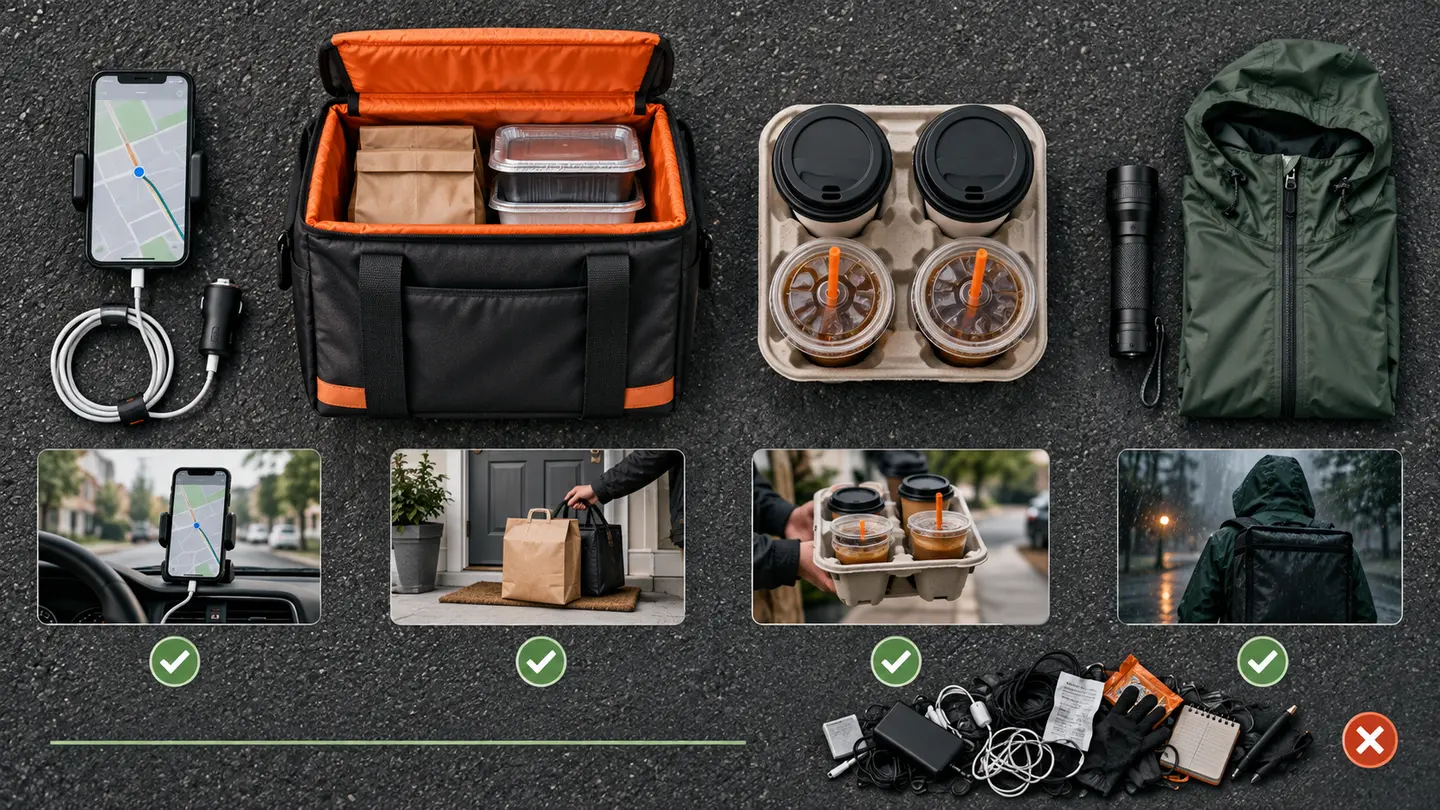
Turn recurring failures into equipment requirements
A purchase becomes easier to judge when the problem is written as an observable failure. “I need better gear” is vague; “the phone loses charge during the last hour” or “two-cup trays slide on the passenger seat” can be measured and corrected.
Keep a seven-shift failure log
Record what failed, where it happened, the order type, weather, vehicle position, and consequence. Repetition distinguishes a real workflow problem from a one-time inconvenience.
Separate essential from conditional gear
Navigation, power, order containment, and safe visibility support core work. Pizza bags, trunk dividers, rain shells, or dash cameras become essential only when the route mix and conditions make them so.
Calculate the burden of ownership
Every item must be stored, cleaned, charged, inspected, and reached safely. A tool that solves a minor problem but adds loose cables, blocked space, or daily setup time may be a net loss.
Example: if battery loss appears only on bright, hot afternoon shifts, a cooler mounting position and verified cable may address the cause before a new charger does.
Reader decision guide
| Question | What a useful answer includes |
|---|---|
| What interrupts paid work? | Prioritize failures that stop navigation, communication, order control, or safe completion. Comfort upgrades come after reliability. |
| Does equipment solve the cause? | A new accessory will not correct poor placement, an overloaded socket, unrestrained cargo, or inconsistent loading by itself. |
| Will it fit every work mode? | Account for passengers, shared vehicles, grocery loads, restaurant bags, stairs, weather, and storage between shifts. |
| Can it be maintained? | Include charging, drying, cleaning, consumables, inspection, replacement parts, and time required to reset the system. |
Common mistakes
- Buying a complete influencer gear list before observing personal failure patterns.
- Treating popularity, review count, or price as evidence of fit or durability.
- Leaving newly purchased gear loose in the cabin because its permanent zone was never planned.
Questions drivers ask
How many shifts should I observe first?
Seven varied shifts are a useful starting record, but rare weather or order types may require longer observation.
Should I carry a backup for everything?
No. Back up failures that would end the shift and cannot be recovered safely nearby; too many backups become clutter.
When is specialized gear justified?
When a repeated, documented job cannot be handled reliably by the current setup and the new item has verified fit.
Sources and evidence notes
NHTSA — Distracted DrivingDefines distraction broadly, including navigation-system interaction, and emphasizes that driving requires full attention.DoorDash — Delivery Driver Gear GuideCurrent platform guidance discussing insulated bags, phone mounts, charging, drink carriers, and specialized bags.Uber — Delivery Gear IdeasPlatform guidance and driver-reported uses for bags, mounts, flashlights, cupholders, and organizers.Found an error or outdated requirement? See our editorial and corrections policy.