HANDLING GUIDE
Preventing drink spills during food delivery
Reduce spills by controlling cup fit, lid condition, carrier support, vehicle placement, and handling before the vehicle moves.
Most drink failures are a chain: a lid is not fully seated, the carrier does not match the cup, the base is uneven, and normal braking finishes the spill. No holder eliminates driving forces. A repeatable pickup check and a stable travel zone matter more than a product claim by itself.
Inspect before leaving the counter
While still at the pickup location, confirm the number of drinks and look for visibly tilted lids, damaged cup walls, overfilled openings, leaking seams, or weak cardboard. Do not open sealed packaging. Ask the restaurant to correct a visible packaging issue rather than modifying the order yourself.
Check that every cup reaches the bottom of its carrier opening and is not pinched high on the rim. Very narrow, wide, tall, or top-heavy cups may not match a standard carrier.
Fit the carrier to the cup
| Risk | What to observe | Setup response |
|---|---|---|
| Loose opening | Cup moves laterally with light parked handling | Use a correctly sized insert or carrier |
| Shallow support | Tall cup sits mostly above the carrier | Increase side support without pressing the lid |
| Uneven load | One drink occupies a multi-cup tray | Balance only with clean, non-order support designed for the carrier |
| Weak tray | Cardboard flexes when lifted | Support the entire base with a rigid holder |
| Mixed heights | Tall cup contacts a lid, bag, or seat | Create clear vertical space |
Create a level, restrained travel zone
Place drinks on a flat surface where the carrier cannot slide or tip under normal braking and turning. Keep them out of the driver footwell, away from vehicle controls, and separate from loose cargo. A waterproof, cleanable tray can contain a leak, but its edges should not interfere with the carrier base.
A seat may look flat while its cushion slopes. Test the empty carrier while parked and inspect the direction it naturally leans. Use a purpose-designed stable platform or another cargo area if needed; do not build a stack of loose objects.
Separate drinks from hot food
Do not place cold drinks loose inside a warm food compartment. Besides temperature conflict, flexible bag walls and food packages can press lids or cups. Use a dedicated holder beside the insulated bag, or a rigid compartment that prevents contact.
Drive for the load
Secure everything before selecting the next route step. Smooth acceleration, earlier braking, and slower turns reduce forces on the order, but drivers must always respond to traffic and road safety first. If something shifts, stop in a safe lawful place before adjusting it.
Thirty-second drink check
- Count matches the pickup information.
- No visible lid, cup, seam, or carrier damage.
- Each cup sits fully and upright in a correctly sized opening.
- Carrier base is supported and restrained on a level surface.
- Drinks are separated from hot food and loose cargo.
- Handoff path can be completed with a level carry.
What a spill test must disclose
A fair carrier comparison would use the same cup dimensions, fill mass, lid type, carrier loading pattern, surface angle, acceleration and braking inputs, turns, duration, and leak inspection. GigStriker has not completed that protocol and does not name a winning carrier.
Next: arrange a repeatable food-delivery car setup or choose the right insulated bag size.
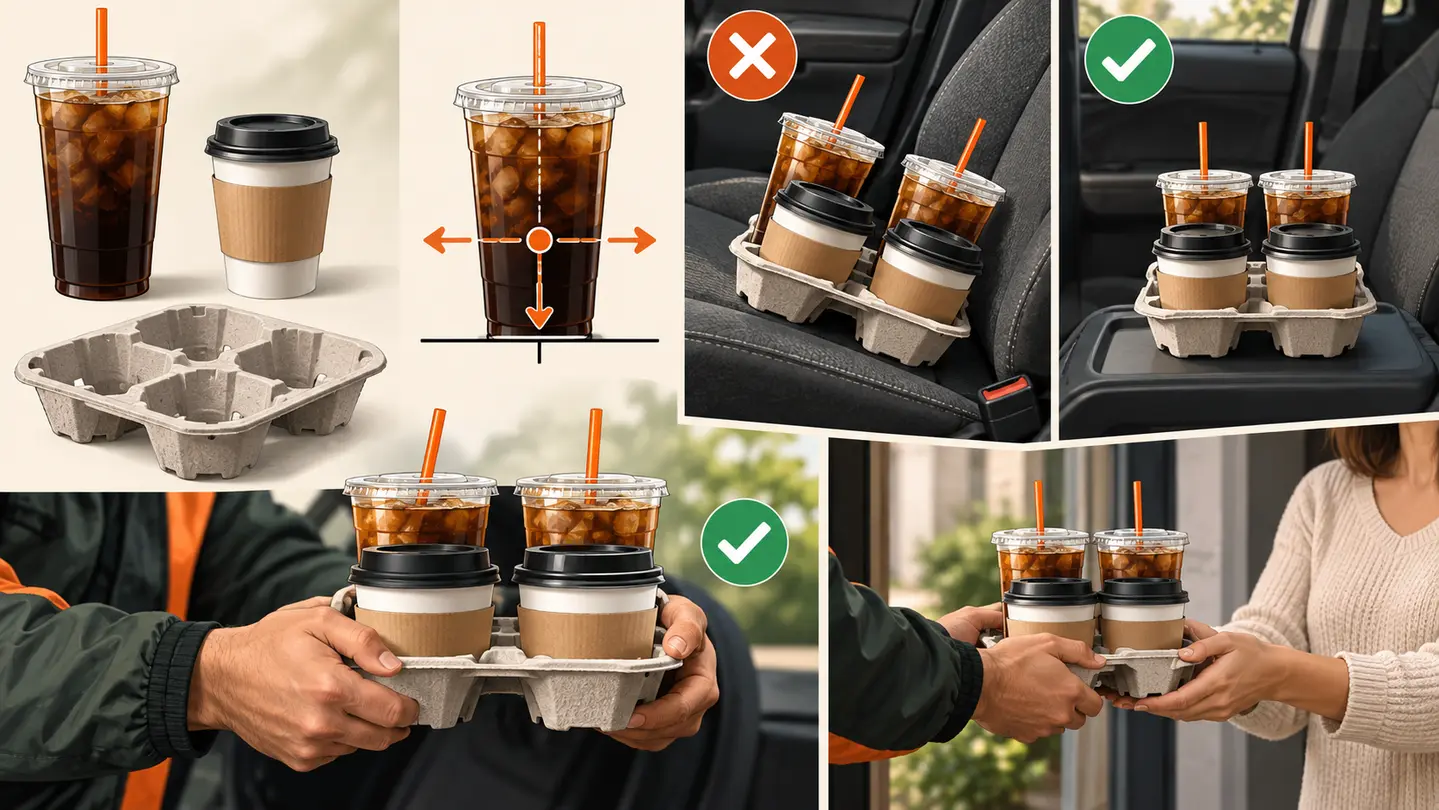
Stability depends on the cup-carrier-surface chain
A secure cup can still spill if the tray flexes; a strong tray can still tip on a sloped seat. Evaluate every interface from lid to vehicle floor instead of treating the holder as the whole solution.
Check center of mass
Tall drinks and dome lids place more mass above the carrier. Greater side support and a broad base may be needed even when the cup diameter fits the opening.
Balance asymmetric loads
One cup in a four-place tray can twist weak cardboard. Use a rigid, clean support designed for the carrier rather than placing customer food or improvised loose objects in empty openings.
Plan the handoff transition
Many spills occur while lifting from the vehicle. Confirm that handles, doors, seat edges, and other orders do not force a tilted extraction, and use two hands when the load requires it.
The last 20 feet can be riskier than the drive if a stable carrier must be lifted one-handed while opening a gate or climbing wet steps.
Reader decision guide
| Question | What a useful answer includes |
|---|---|
| Does the opening support the cup low enough? | A tall cup held only near its base remains top-heavy; inspect cup diameter, height, taper, and how much side wall is supported. |
| Is the carrier structurally supported? | Flexible cardboard needs a rigid clean base that stays level and does not bend during lifting. |
| What happens with an uneven count? | One or three cups can load a multi-place tray asymmetrically; test the exact pattern without using customer food as a brace. |
| Can the carrier leave the vehicle level? | Plan the door opening, handle grip, second hand, walking route, gate, stairs, and customer transfer. |
Common mistakes
- Assuming a cup that fits the hole cannot tip or lift out.
- Setting a rigid carrier on a deeply sloped cushion without a level platform.
- Waiting until the vehicle moves to discover a lid, carrier, or placement problem.
Questions drivers ask
Should lids be opened to check them?
Do not open sealed or prepared drinks. Look for visible defects and ask the merchant to correct questionable packaging.
Can absorbent liners prevent spills?
They may contain small leakage but do not stabilize cups or repair lids; they also require cleaning or replacement.
What should I do if a drink shifts?
Stop in a safe lawful place before handling or repositioning it.
Sources and evidence notes
DoorDash — Delivery Driver Gear GuideCurrent platform guidance discusses drink carriers and equipment used to reduce movement and spills.Uber — Delivery Gear IdeasPlatform guidance includes extra drink holders and trunk organizers among driver-reported equipment ideas.NHTSA — Distracted DrivingSafety guidance supporting secure setup before driving and avoiding attention-diverting adjustments on the road.Found an error or outdated requirement? See our editorial and corrections policy.