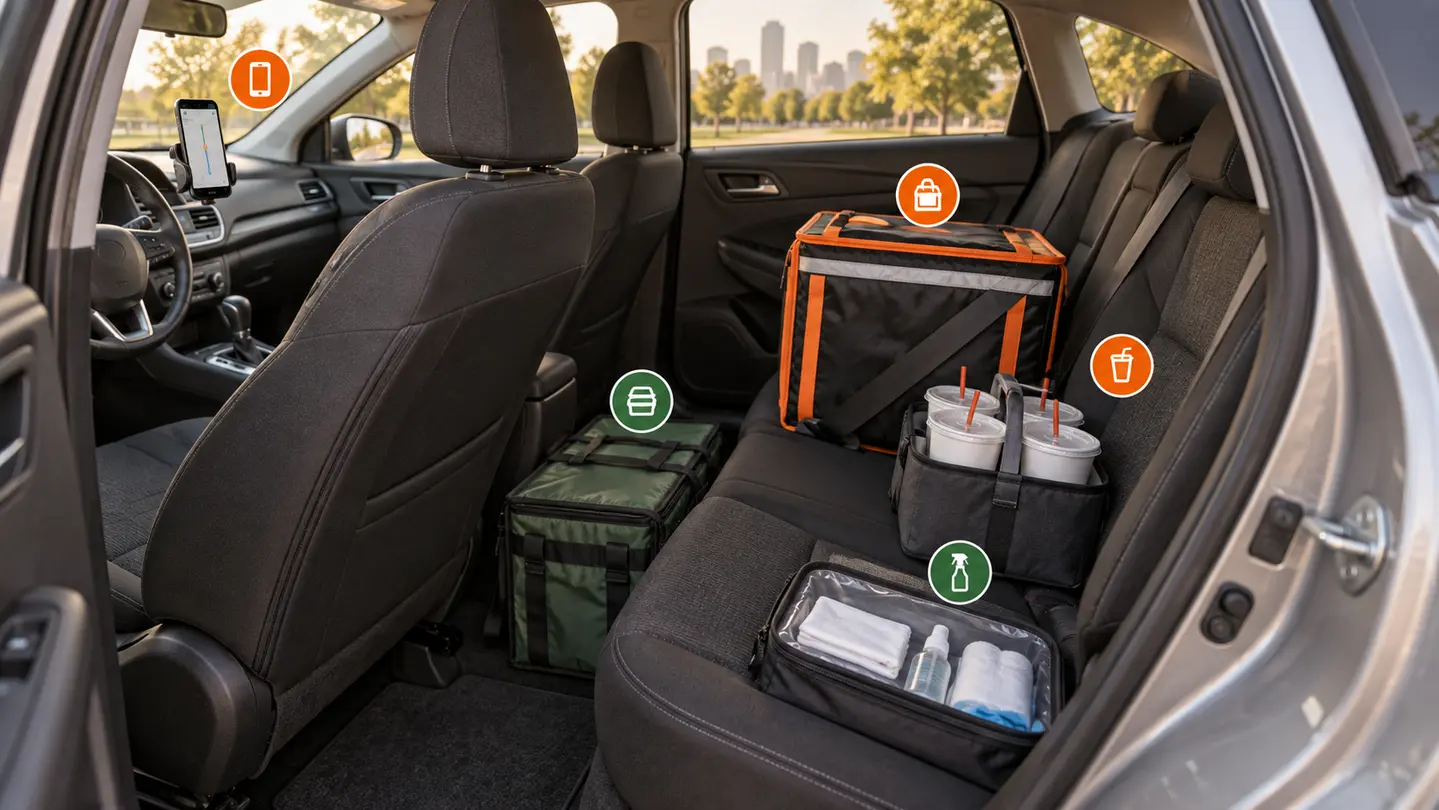
Give navigation, active orders, drinks, cleanup supplies, and personal items distinct working zones.
By GigStriker Editorial TeamPublished September 6, 2026Updated September 6, 2026
Evidence label: Research synthesisThis page does not contain product rankings or hands-on performance claims.
A good setup makes the correct action obvious at each stop. It should help you load without guessing, identify each order, prevent loose items from reaching the pedals, and reset the vehicle quickly after a spill. The layout must fit your vehicle and passenger needs; there is no universal diagram.
Use five working zones
1. Driver information zone
Keep the mounted phone visible without materially blocking the road, mirrors, controls, or airbag areas. Route the cable so it cannot catch the shifter, steering controls, parking brake, or your legs. Make every adjustment while parked.
2. Active-order zone
Choose one consistent position for the order you are currently delivering. In many vehicles that may be the passenger-side floor, seat, or rear seat, but seat slope and braking can make an unsecured bag unstable. Use a level, restrained surface and never stack beyond what the bag can support.
3. Drink zone
Keep drinks upright, separated from hot bags, and supported near their base. Check carrier openings against common cup sizes before trusting them. Avoid footwells used by the driver and any place where a spill could reach electronics or controls.
4. Reserve and multi-order zone
Use the rear seat or cargo area for queued orders. Give each order a repeatable left/right or front/rear position and verify the customer name at both loading and unloading. Physical separation is more dependable than remembering which bag went where.
5. Cleanup and personal zone
Keep wipes, absorbent material, spare liners, and waste bags separate from food. Personal food, jackets, and loose equipment need their own space so they are not mistaken for an order or placed against a customer’s packaging.
Match the layout to the vehicle
Vehicle constraint
Adjustment
Sloped passenger seat
Use a level base or another restrained zone; do not assume a soft bag will remain upright.
Small cabin
Favor collapsible equipment and one active-order position rather than permanent organizers.
SUV or hatchback
Prevent cargo-area sliding and preserve rear visibility.
Shared family vehicle
Use a removable kit with a defined storage container and reset checklist.
Run a parked dry test
Place an empty representative bag and drink carrier in their planned positions.
Check seat belts, airbags, mirrors, controls, pedals, and sightlines.
Simulate loading two labeled orders and retrieving the second one.
Verify that nothing must be rearranged while the vehicle is moving.
Remove everything and time the reset; complicated systems tend not to remain consistent.
Before moving
Phone mounted, route started, cable clear
Containers closed and order identity verified
Drinks supported and separated
All cargo restrained against normal braking and turning
Nothing loose near pedals, controls, or airbags
Clean between problems, not only between shifts
When a leak occurs, isolate the affected bag or liner before loading another order. Follow the bag manufacturer’s cleaning directions. Do not make unsupported sanitation claims based only on a surface looking clean.
Instructional illustration. Distinct vehicle zones make order identity, restraint, and cleanup easier to manage. Digitally created and reviewed by the GigStriker Editorial Team; it is not a product test or proof of performance.
Design the setup around movement and recovery
A static layout can look organized and still fail during braking, multi-order pickups, or cleanup. Evaluate how objects move, how the next order is identified, and how quickly a contaminated zone can be removed from service.
Use repeatable visual identity
Assign the same position or color marker to each active order and verify the customer at loading and unloading. Do not rely on the restaurant bag’s appearance; two orders may use identical packaging.
Test normal forces while empty
With the vehicle parked, push each empty carrier forward, sideways, and upward to reveal sliding, tipping, or weak dividers. Then repeat with representative non-food ballast before trusting the system.
Preserve an isolation path
A leaking liner or failed cup holder needs somewhere to go without contacting another order. Keep a clean, separate containment item accessible without unloading the entire vehicle.
Apply it to a shift
A two-order dinner run should be loadable, identifiable, and removable without moving the other customer’s food or reaching across the driver area.
Affiliate disclosure: This section contains Amazon affiliate links. As an Amazon Associate I earn from qualifying purchases.
SPECIFICATION-VERIFIED CANDIDATES
Products worth checking for fit—not untested winners
These are research candidates selected because the manufacturer publishes relevant specifications. Inclusion is not a ranking, endorsement, or hands-on performance claim.
FORTEM Original Trunk Organizer Large (50L)
Why it made the shortlist: FORTEM documents reinforced base plates, up to three compartments, side pockets, non-slip strips, adjustable securing straps, and a collapsible configuration. Those features make it a useful candidate for the guide’s removable reserve-zone and multi-order organization checks when the measured cargo area allows it.
Verify before buying: Measure the vehicle and loading opening, confirm usable anchor points, and keep customer orders in appropriate closed delivery bags or packaging. The organizer is not established crash restraint, insulation, food-contact equipment, spill containment, or sanitation equipment. GigStriker has not independently tested loaded stability, cleanability, handle strength, or durability.