TEST METHOD · VERSION 1.0
How we test insulated delivery bags
A bag earns a performance conclusion only when its load, environment, timing, measurements, and limitations are disclosed.
Questions the protocol answers
The test separates five issues that marketing often blends together: usable capacity, temperature change, closure integrity, load stability, and cleanup. A bag may perform well in one area and poorly in another; GigStriker will report each result rather than collapse everything into an unexplained score.
1. Document the test article
- Manufacturer, model, stated size, materials, and closure type
- Measured exterior and usable interior dimensions
- Empty mass and any removable divider or base
- Condition, age, prior use, and cleaning history
- Whether the product was purchased, borrowed, or supplied
2. Use repeatable loads
Tests must identify the container shape, fill material, starting mass, placement, and starting temperature. Hot and cold trials are separate. Results from a small container centered in a large bag cannot be generalized to a full restaurant load.
3. Record the environment
Measure ambient temperature at the test location and inside the vehicle or room as applicable. Report direct sun, vehicle climate control, bag location, preconditioning, and whether the bag was opened during the interval. These variables can change the result substantially.
4. Measure on a schedule
Use the same calibrated or cross-checked temperature instruments and sensor positions for every candidate. Record the start, then fixed intervals appropriate to the test—such as 15, 30, 45, and 60 minutes. Report measured change; do not claim the test proves food is safe to eat.
5. Check practical fit
| Measure | Procedure |
|---|---|
| Usable opening | Measure the narrowest closure opening, not only the widest body panel. |
| Closure | Load to the defined level and verify complete closure without crushing the test package. |
| Stability | Use the same restrained vehicle position and disclosed route or controlled movement sequence. |
| Leak containment | Use a safe test liquid and disclosed volume; never use customer food. |
| Cleaning | Follow the manufacturer method, then inspect seams, liner, odor, drying time, and retained moisture. |
Comparison rules
Every product in a comparison must use the same protocol version, load, instruments, environment range, timing, and scoring definitions. Deviations are reported beside the result. We will not infer a winner from manufacturer insulation thickness, review count, or a single uncontrolled trip.
Required publication record
- Raw measurements and test dates
- Photos of configuration and sensor position
- Instrument identification and verification check
- All deviations, failures, and retests
- Who performed and reviewed the test
Current status
The protocol is ready for use, but GigStriker has not yet completed a qualifying product comparison. No bag currently holds a GigStriker ranking or winner designation.
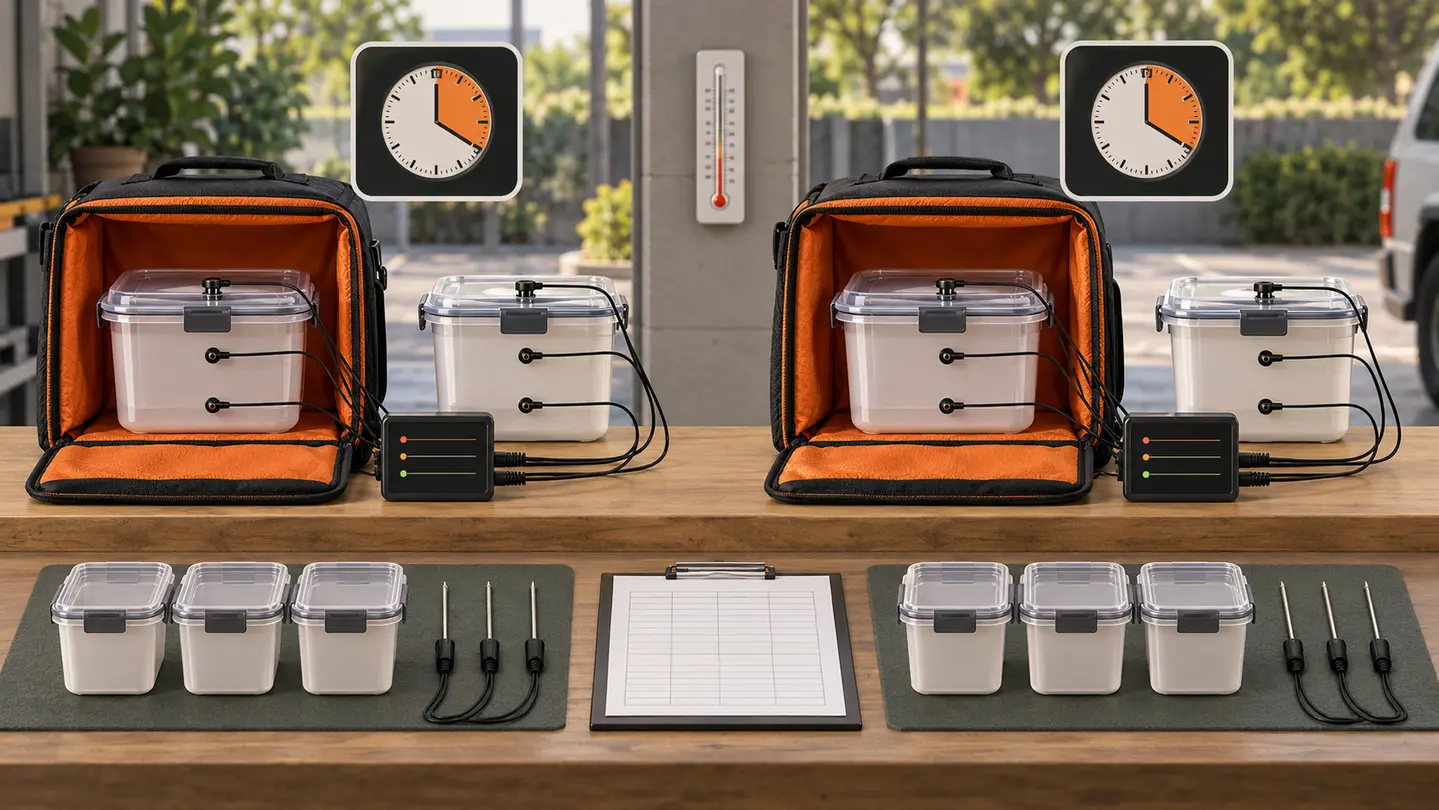
Turn a temperature trial into useful evidence
A single start-and-finish reading can miss where heat is moving and why. Repeatable bag testing controls the load, sensor position, opening events, environment, and measurement schedule.
Use more than one measurement point
A sensor near the lid may change differently from one near the center or base. Document exact placement and prevent probes from touching heating elements, ice packs, or container walls unless that contact is the subject of the test.
Run an uncovered control
A reference load exposed to the same environment helps show how much change occurred without the bag. It does not eliminate all variability, but it gives the insulated result meaningful context.
Separate retention from food safety
The protocol measures temperature change under stated conditions. It does not certify that unknown restaurant food was prepared, held, or delivered within regulatory limits.
If a bag is opened at 20 minutes while another remains sealed, the results describe two workflows—not a clean product comparison.
Reader decision guide
| Question | What a useful answer includes |
|---|---|
| What is the reference load? | Document container material, dimensions, mass, contents, starting temperature, placement, and whether the load fills the bag. |
| Where are sensors placed? | Record lid, center, base, or other positions precisely and prevent unintended contact with container walls or conditioning sources. |
| What is the environment? | Measure ambient and vehicle temperature, direct sun, climate control, bag location, preconditioning, and every opening event. |
| What result is actually supported? | Report temperature change, fit, leakage, or cleaning observations—not a declaration that unknown food is safe to eat. |
Common mistakes
- Using different starting temperatures or fill masses for competing bags.
- Reporting only the most favorable sensor or interval without the raw sequence.
- Calling a bag waterproof after a simple liner leak test that did not test seams, closures, pressure, or duration.
Questions drivers ask
Why include an uncovered control?
It provides context for environmental change without insulation, though it does not remove every source of variability.
Can hot and cold trials be combined?
No. They require separate starting conditions, loads, conditioning, and conclusions.
What should happen after a protocol deviation?
Report it beside the result and repeat when necessary; never silently replace or merge the affected run.
Sources and evidence notes
DoorDash — Delivery Driver Gear GuideIdentifies size, insulation construction, closure, cleanability, carrying style, structure, and order type as relevant bag considerations.Uber — Delivery Gear IdeasProvides platform context for insulated bags and restaurant handling instructions.Found an error or outdated requirement? See our editorial and corrections policy.