ORDER-CONTROL GUIDE
Separating hot, cold, and leaking orders
Use visible zones and a repeatable loading sequence so temperature groups, drinks, and damaged packaging do not become a memory test.
This workflow is about order condition and organization, not certifying food safety. Drivers generally do not know the preparation temperature, internal food temperature, or full handling history. Follow restaurant instructions, platform requirements, package labels, and local rules.
Inspect before the order enters your bag
While still at pickup, confirm the order identity, number of packages, obvious drink count, and any handling directions. Look for wet paper, an open lid, a damaged seal, a leaning container, or condensation that could weaken packaging. If something appears compromised, ask the merchant how it should be handled rather than silently repacking sealed food.
Assign by condition
| Condition | Default zone | Reason |
|---|---|---|
| Hot packaged food | Closed insulated hot-order bag | Reduces exposure to cooler items and vehicle air. |
| Cold or frozen goods | Separate insulated cold-order bag | Avoids placing cold items beside hot packages. |
| Drinks | Supported upright carrier | Keeps tall, top-heavy containers out of soft food stacks. |
| Possible leak | Isolated secondary containment | Limits contact with other orders and vehicle surfaces. |
| Personal items | Non-order zone | Prevents mix-ups and contact with customer packaging. |
Load in a fixed sequence
- Read merchant instructions and identify the order.
- Place hot and cold groups in separate defined zones.
- Support drinks independently; do not use food packages as braces.
- Place the next drop where it can be retrieved without moving another customer’s order.
- Close bags, secure the load, and verify the route while parked.
Do not improvise with sealed orders
A driver should not open sealed packaging to investigate contents or transfer food. If the outer package is leaking, unstable, incorrectly labeled, or clearly damaged, seek direction from the merchant or platform. Document the condition only as permitted by the platform and applicable privacy rules.
Reset after a leak
Remove the affected liner or carrier from active service. Clean it according to its materials and manufacturer instructions, allow it to dry as required, and inspect seams and closures before reuse. A disposable barrier may simplify cleanup, but it does not turn a non-cleanable bag into a hygienic one.
Ten-second departure check
- Correct order and drop sequence
- Hot and cold packages separated
- Drinks upright and supported
- No visible leak touching another order
- Closures shut and load restrained
Where equipment claims stop
An insulated bag can slow temperature change; without controlled measurements, it cannot support a specific duration or temperature promise. Use our insulated delivery-bag protocol to see what a credible retention test must disclose.
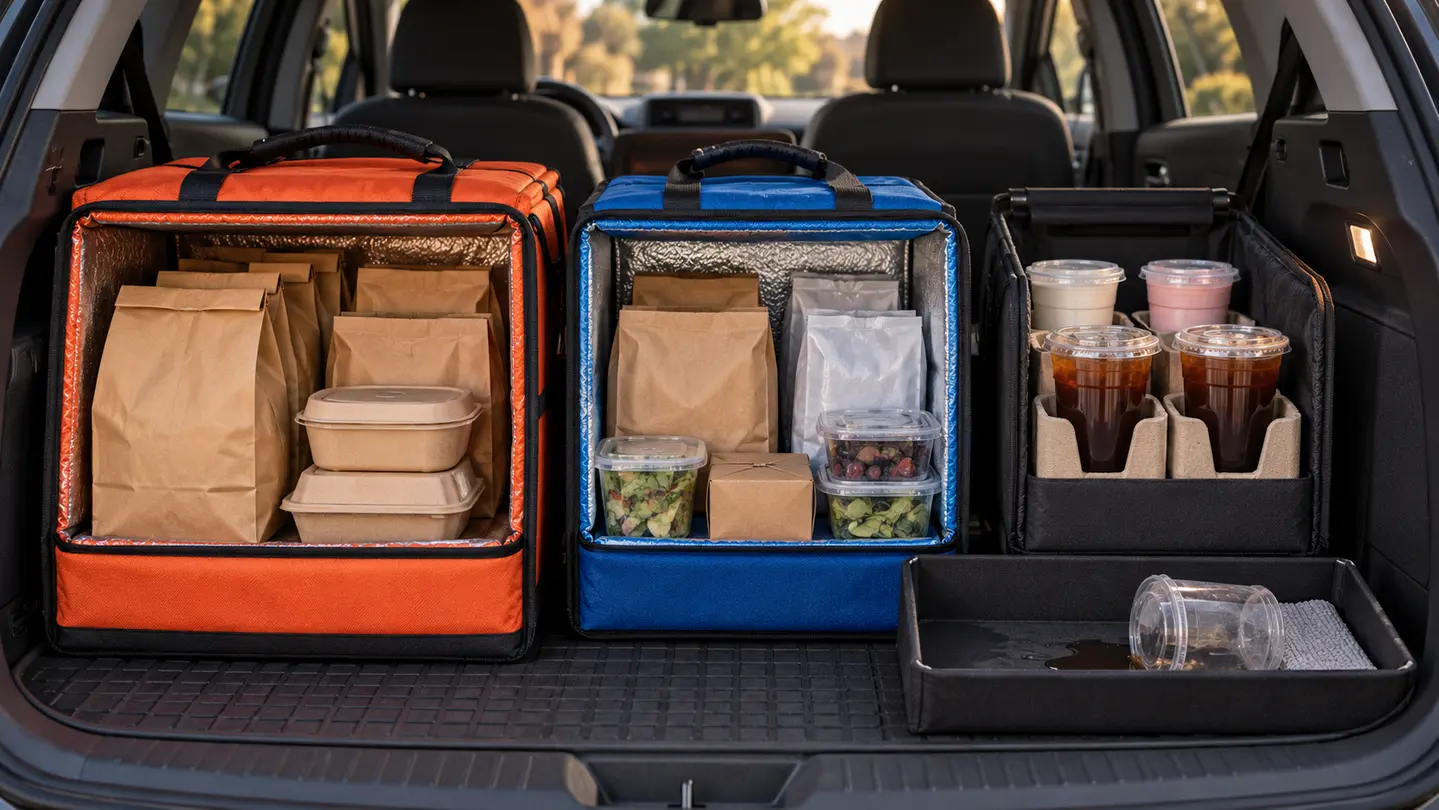
Use barriers according to the failure type
Temperature conflict, liquid leakage, allergen instructions, and customer identity are different problems. One divider does not solve all four, and drivers should not open sealed orders to investigate contents.
Make separation visible
Use dedicated closed bags or clearly distinct zones rather than placing packages together and relying on memory. Verify the order identity every time an item crosses a vehicle boundary.
Escalate compromised packaging
Wet paper, broken seals, open lids, or active leakage should be raised with the merchant or platform before departure. Secondary containment protects other loads but does not repair the original package.
Reset the affected equipment
After a leak, remove the liner or carrier from active use, follow its cleaning instructions, dry it fully as required, and inspect seams and closures before another customer order enters it.
A cold drink carrier beside a hot bag can be acceptable; loose drinks inside the hot compartment create both temperature and pressure risks.
Reader decision guide
| Question | What a useful answer includes |
|---|---|
| Which risk requires separation? | Identify temperature conflict, cup instability, active leakage, customer identity, or merchant handling instructions separately. |
| Is the original package compromised? | Visible wetness, broken seals, open lids, or unstable packaging should be escalated before departure rather than silently repacked. |
| Can containment be removed from service? | A leak tray or liner should leave the active order system without touching another load. |
| Is the next drop accessible? | Stop sequence should not require moving one customer’s package over or through another customer’s zone. |
Common mistakes
- Using one oversized bag for hot food, cold drinks, and leaking containers.
- Opening sealed packaging to investigate or reorganize the contents.
- Treating a disposable barrier as proof that a contaminated non-cleanable bag is ready for reuse.
Questions drivers ask
Does separation certify food safety?
No. Drivers generally lack preparation and internal-temperature history; follow merchant, platform, labeling, and local requirements.
Can hot and cold bags touch?
Physical contact is less important than closed, stable zones that prevent mixing, pressure, leakage, and uncontrolled heat exchange.
How should a leak be documented?
Follow platform and privacy rules, involve the merchant when possible, and avoid capturing unnecessary customer information.
Sources and evidence notes
Uber — Restaurant Guidelines for DeliveryStates that restaurants may provide safety or dietary-separation instructions and delivery people are expected to follow them.DoorDash — Delivery Driver Gear GuideDiscusses insulation, structured bags, spill prevention, cleaning, groceries, and specialized order formats.Found an error or outdated requirement? See our editorial and corrections policy.