FIT GUIDE
Insulated delivery bag size guide
Measure the packages you carry and the usable space inside the bag—not a vague capacity label.
A large bag is not automatically more useful. Extra space can allow containers to slide, while a tight closure can crush packaging. The correct size is the smallest usable interior that accepts your recurring order shapes, closes without pressure, and fits securely in your vehicle.
Build an order-size record
For several shifts, record the length, width, and height of the largest recurring restaurant bags or grocery loads. Measure the package at its widest points, including folded tops, handles, drink trays, and containers that protrude. Note which items must remain upright and which hot and cold items need separation.
Do not use a single unusual catering order to define an everyday bag. Mark it separately as an exception that may justify a second format later.
Measure usable interior space
| Measurement | How to take it | Easy mistake |
|---|---|---|
| Interior length | Inside wall to inside wall with liner installed | Using the larger exterior dimension |
| Interior width | Narrowest usable point after structure and pockets | Ignoring tapered walls |
| Interior height | Base to the point where the closure works freely | Counting space needed by a zipper or flap |
| Opening | Clear width and diagonal while loading | Assuming an item that fits inside also fits through the opening |
Allow modest clearance for loading and unloading. The correct allowance depends on packaging stiffness, handles, the closure, and whether dividers are installed; there is no universal extra-inch rule.
Match geometry to the order
Tall restaurant bags need upright height and a broad enough base. Pizza needs horizontal footprint and level support. Grocery orders may need structure, compartments, and manageable carry weight more than maximum volume. Drinks are usually safer in a fitted carrier placed beside the food rather than loose inside a large cavity.
If stacked orders are common, separation may be more useful than raw capacity. Dividers should stay in position and should not press lids or let cold items share a compartment with hot food.
Verify the vehicle fit
Measure the seat, floor, trunk, bike rack, or cargo platform where the bag will ride. Check the loading path through the door or hatch. Confirm that the filled bag can be restrained from sliding and that it does not enter the driver footwell, obstruct controls, or become an unsecured heavy object.
Also consider the carry path. A bag that fits the vehicle may be awkward through apartment doors or stairs when full. Load it to a representative weight and judge handle position and balance before relying on it.
Size decision record
- Largest recurring package dimensions are documented.
- Bag listing provides internal—not only external—dimensions.
- Opening and closure clear the package.
- Hot, cold, fragile, and drink items can be separated.
- Bag fits through the vehicle opening and in its secured travel zone.
- Liner and corners can be reached for cleaning.
What size cannot prove
Dimensions can establish fit, but they cannot establish temperature retention, leak resistance, seam durability, or cleanability. Temperature claims require a disclosed load, starting temperature, ambient conditions, time, and measurement points. GigStriker has not ranked bags without that comparable evidence.
For the testing standard, read how we evaluate insulated bags. For flat orders, continue to the pizza bag fit guide.
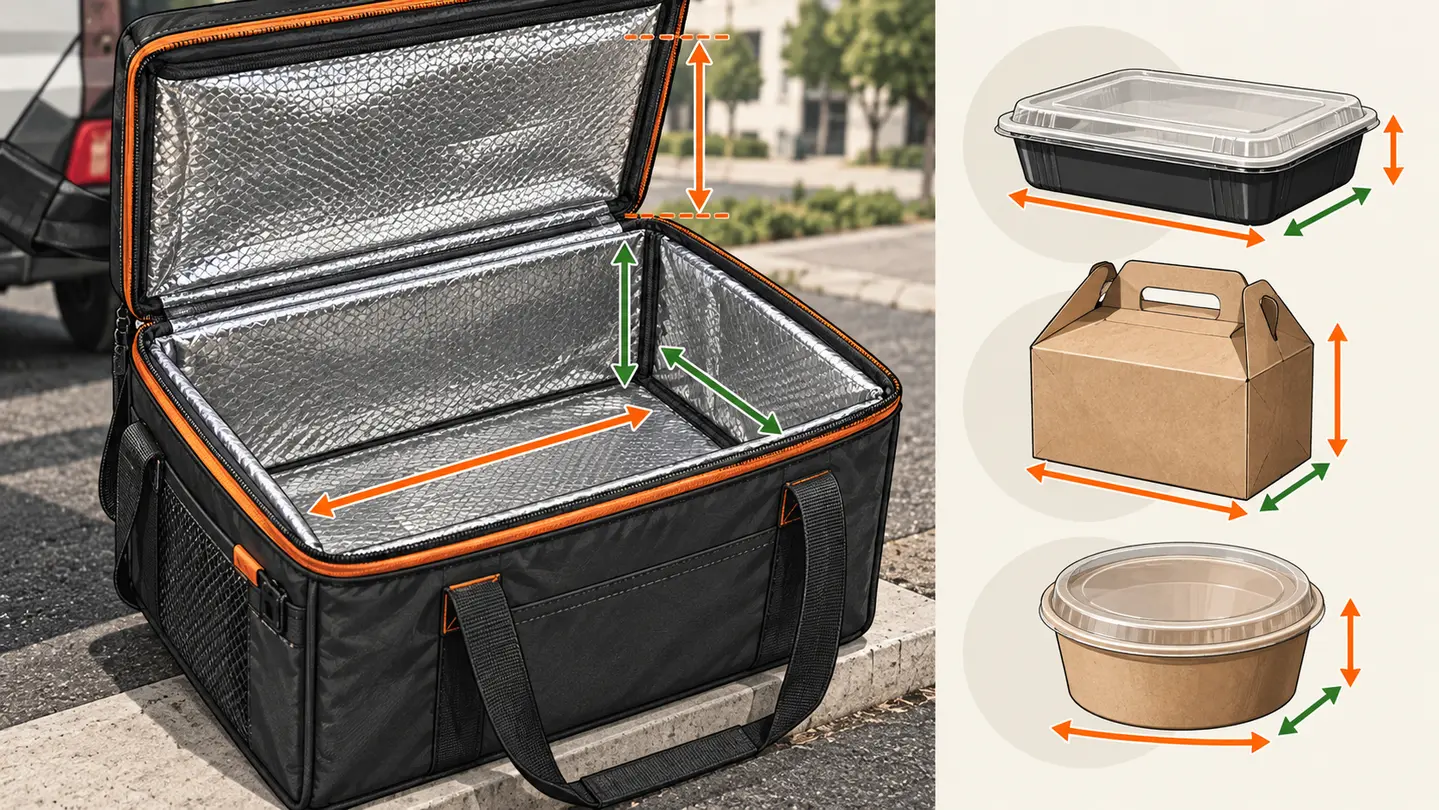
Capacity is geometry, not a single number
Two bags with similar advertised volume can carry very different orders because the opening, taper, liner, divider, closure, and base stiffness consume usable space.
Create three reference loads
Measure a common tall restaurant bag, a wide flat order, and a realistic stacked order. These reveal more than filling the bag with loose objects that do not resemble delivery packaging.
Check loaded access
Practice lifting the center or bottom package without crushing the others. A bag that technically holds the load may still require tilting, squeezing, or unloading at the customer’s door.
Account for thermal mass and empty space
Size affects how much unused air surrounds a load, but dimensions alone cannot predict temperature change. Only a controlled protocol can separate bag construction from load size and starting conditions.
An extra-large bag can be worse for a single narrow order if the package slides and the soft walls fold against lids during turns.
Reader decision guide
| Question | What a useful answer includes |
|---|---|
| What shapes recur? | Measure the largest common tall bag, wide flat order, stacked order, and opening path instead of relying on liters or exterior size. |
| Can the closure work freely? | Usable height ends where the zipper or flap closes without pressing packages, not at the tallest exterior seam. |
| Will it travel level? | Confirm the filled footprint fits a stable, restrained vehicle zone and passes through the door or hatch without rotation. |
| Can it be cleaned fully? | Inspect liner seams, corners, removable bases, dividers, pockets, drying access, and manufacturer care restrictions. |
Common mistakes
- Using exterior dimensions as if insulation, taper, pockets, and structure consume no space.
- Sizing every shift around one rare catering order and allowing common orders to slide.
- Ignoring the opening diagonal, then tilting or flexing packaging to get it inside.
Questions drivers ask
How much clearance should I add?
Enough for smooth loading and closure without uncontrolled movement; packaging stiffness and bag structure prevent one universal allowance.
Does a larger bag retain heat longer?
Size alone cannot establish retention. Load mass, empty air, construction, openings, start temperature, and environment all matter.
Should drinks share the bag?
Only in a dedicated stable compartment that avoids lid pressure and temperature conflict; loose cups should not ride with food.
Sources and evidence notes
DoorDash — Delivery Driver Gear GuideCurrent platform guidance discusses insulated bags, sizing, cleaning, structure, and specialized pizza or grocery formats.Uber — Delivery Gear IdeasPlatform guidance describing insulated bags and other equipment used by delivery workers.Found an error or outdated requirement? See our editorial and corrections policy.