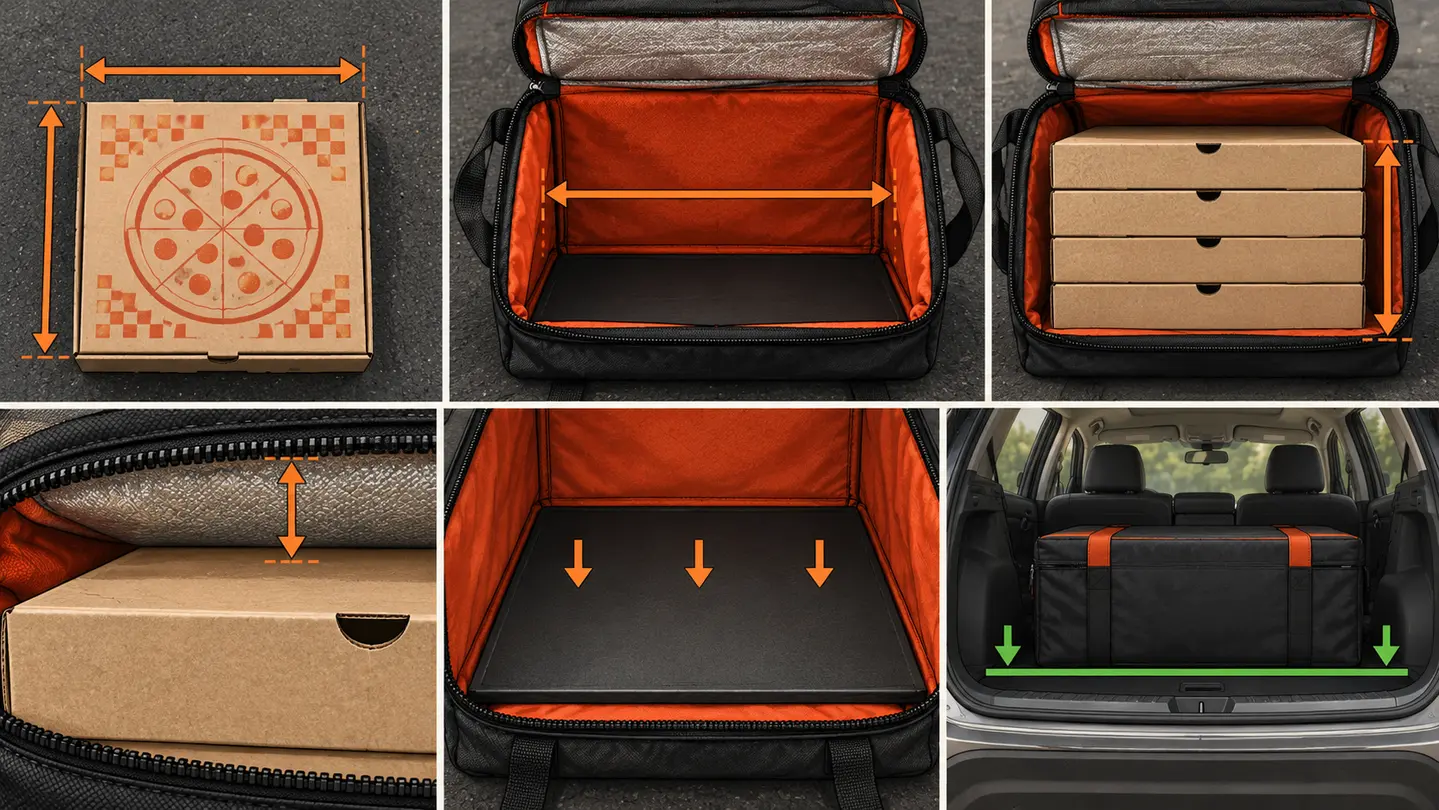
A pizza bag must fit the box, the stack, the loading motion, and a level travel surface—not merely claim a familiar size.
By GigStriker Editorial TeamPublished September 6, 2026Updated September 6, 2026
Evidence label: Research synthesisThis page does not contain product rankings or hands-on performance claims.
Pizza packaging is wide, flat, and sensitive to tilt and compression. Start with the boxes supplied by restaurants in your area. A nominal pizza diameter does not necessarily equal the outside dimensions of its box.
Measure the box, then the stack
Measure the outside length and width of the largest recurring box. Measure height at the tallest point without pressing the lid. For multiple-box orders, measure the realistic stack and include any corrugated tabs, liners, or containers placed on top.
Record square boxes by both dimensions even when they appear equal. Specialty boxes and folded handles can change the footprint. If oversized orders are rare, treat them as exceptions instead of making every trip use an unnecessarily large bag.
Check the opening separately
A box can fit the main compartment but catch on a narrow zipper, flap, or reinforced edge. Compare the clear opening with the box diagonal and the motion needed to load it while keeping it level. The bag should close without bending the box or pressing the lid.
Fit point
Verify
Failure sign
Footprint
Usable interior exceeds actual box length and width
Corners bow or zipper strains
Height
Closure clears the representative stack
Lids press downward
Opening
Box loads flat without force
Driver must tilt or flex the box
Base
Bag rests level on the travel surface
Stack slides toward one edge
Handles
Loaded bag stays balanced when carried
Bag folds or stack tilts
Plan the vehicle position
Identify a level, clean area before pickup. Sloped seats may need an appropriate stable platform or a different cargo zone; do not improvise with loose objects that can shift. The bag and load should be restrained from sliding without crushing the boxes.
Keep pizza away from the driver footwell and controls. Do not place other food or drinks on top unless the packaging and bag provide a dedicated, stable separation system.
Temperature and venting are separate questions
A fitted insulated bag may help reduce heat exchange, but fit alone does not prove temperature performance. Pizza boxes can release moisture, and handling practices differ by restaurant. Follow restaurant or platform instructions and do not claim a bag “keeps pizza hot” for a set time without a controlled test.
Pizza fit worksheet
Largest recurring box: length × width × height.
Representative stack height documented.
Usable interior and clear opening verified.
Closure works without touching box lids.
Level, secured vehicle position identified.
Loaded carry test stays balanced and horizontal.
Evidence boundary
GigStriker has not ranked pizza bags. A meaningful comparison would control the box stack, starting temperature, ambient temperature, trip time, measurement locations, loading method, vehicle position, and cleaning cycle.
Instructional illustration. Pizza fit follows the square box and stack through the entire loading and carrying path. Digitally created and reviewed by the GigStriker Editorial Team; it is not a product test or proof of performance.
Flat loads fail differently from upright bags
Pizza quality can be affected by tilt, lid pressure, stack movement, and moisture as well as temperature. The bag must preserve a flat support plane from restaurant counter to customer handoff.
Trace the entire loading path
Measure restaurant door clearance, vehicle opening, travel surface, and final carry. A box that fits inside the bag may still require damaging rotation to enter a small rear door.
Control stack compression
Closures and handles should not bow the upper lid. Measure the stack at tabs or raised corners and verify that lifting the bag does not fold its center onto the boxes.
Treat mixed orders separately
Side items and drinks should not ride on top of pizza unless a rigid compartment is designed for them. Hot flat food, cold drinks, and tall containers impose conflicting support needs.
Apply it to a shift
A bag advertised for a particular pizza diameter may still be too small because the square box, folded tabs, and closure—not the pizza—determine fit.
Affiliate disclosure: This section contains Amazon affiliate links. As an Amazon Associate I earn from qualifying purchases.
SPECIFICATION-VERIFIED CANDIDATES
Products worth checking for fit—not untested winners
These are research candidates selected because the manufacturer publishes relevant specifications. Inclusion is not a ranking, endorsement, or hands-on performance claim.
Cambro Standard Pizza Bag (GBP216)
Why it made the shortlist: Cambro specifies interior dimensions of 16.5 × 18 × 6.5 inches and capacity for two 16-inch or three 14-inch pizza boxes. The maker also documents 600-denier polyester, high-density insulation, nylon straps, and a vertical hook-and-loop closure. Those published measurements make this a useful candidate for the guide’s box, opening, closure, and vehicle-placement checks.
Verify before buying: Measure the actual pizza boxes you receive—including handles, seals, toppers, and stacked height—then confirm the bag opening, closure allowance, loaded carry path, and stable placement in your vehicle. Published capacity does not establish fit for every restaurant box. GigStriker has not independently tested heat retention, condensation, seam strength, cleanability, loaded handling, or long-shift durability.