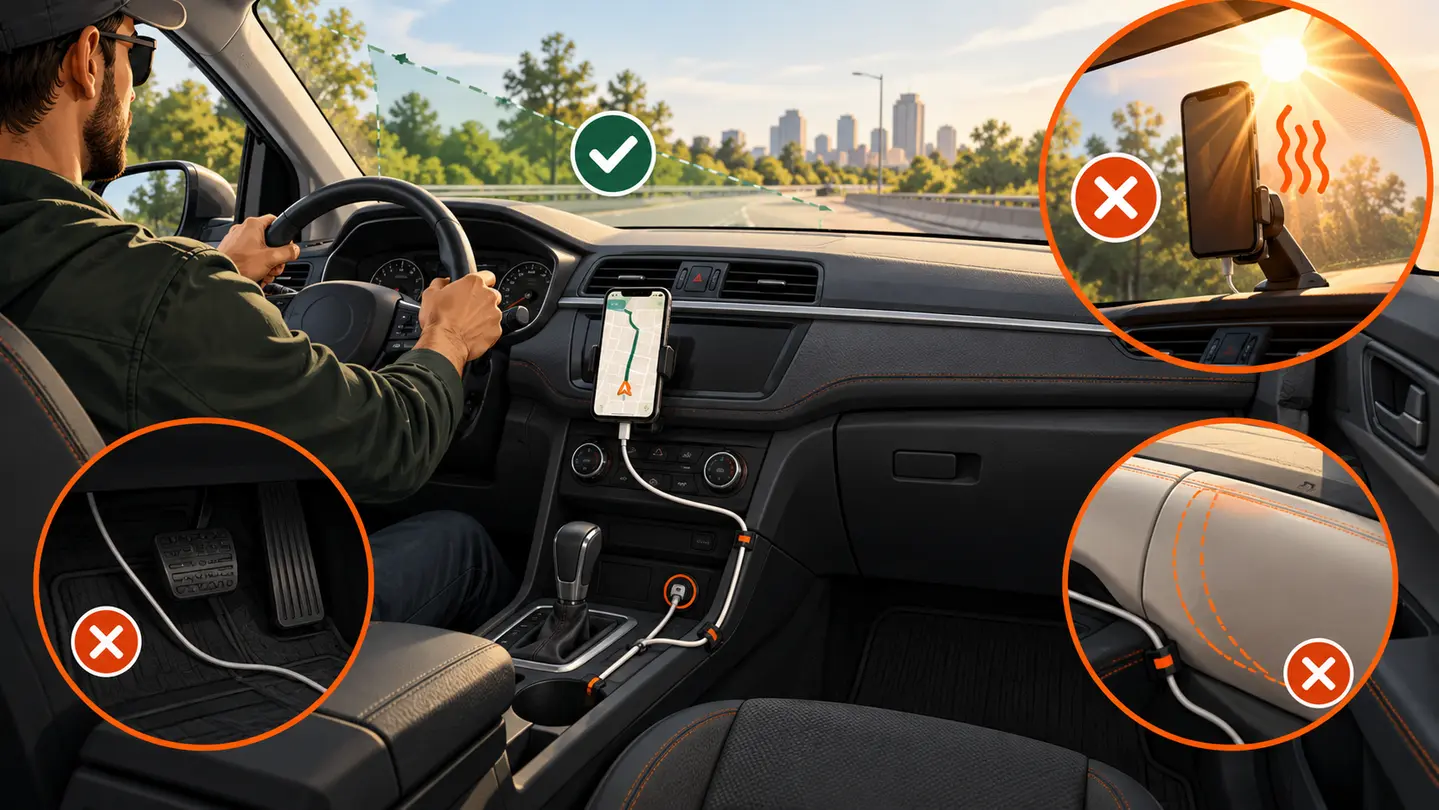
Choose a mounting system only after the location, attachment surface, phone, case, cable, and driving controls all fit together.
By GigStriker Editorial TeamPublished September 6, 2026Updated September 6, 2026
Evidence label: Research synthesisThis page does not contain product rankings or hands-on performance claims.
A mount is a small system, not a single clamp. It must attach securely to the vehicle, retain the phone and case, leave room for charging, and occupy a lawful location that does not interfere with visibility or controls. A product can be well made and still be wrong for a particular dashboard.
Start with the mounting location
Location
Fit questions
Common constraint
Windshield
Is there clean glass and enough arm reach?
Local placement rules and blocked sightlines
Dashboard
Is the surface flat, clean, and compatible with the base?
Texture, curvature, coatings, and summer heat
Vent
Do the clip and vent slats match?
Weak or vertical slats, moving louvers, airflow
Console or cupholder
Does the base fit without blocking controls?
Low glance angle and lost storage
Check the laws where you drive before choosing a windshield or dashboard position. Even a lawful location can be a poor choice if it hides mirrors, warning lights, the road edge, or a vehicle control.
Measure the phone as it is actually used
Measure width, height, thickness, and weight with the everyday case installed. Include a wallet, finger loop, magnetic plate, camera bump, or battery attachment. Confirm that side arms will not press power or volume buttons and that the lower support leaves the charging port open.
If you switch phones or share the vehicle, measure the largest setup and the adjustment range needed for the smallest one. “Universal” describes an intended range, not proof of fit.
Match the attachment to the vehicle
For vent mounts, inspect slat direction, thickness, depth, and movement. A clip that holds a rigid horizontal slat may twist on a round or freely rotating vent. For adhesive or suction bases, inspect texture and curvature and follow the manufacturer’s preparation, temperature, and curing instructions. Do not assume an adhesive pad can be moved and retain its original bond.
Position the phone before fixing the base. With the vehicle parked, confirm that you can see the screen, connect the cable, shift gears, use climate controls, and turn the steering wheel without contact.
Check the complete charging path
A cable can pull a mount out of alignment. Route it with slack at the phone and keep it away from pedals, steering, shifter movement, seat tracks, airbags, and sharp edges. Test both portrait and landscape orientation if your workflow uses both.
Parked-vehicle fit check
Phone and case enter and leave the holder without forced bending.
Buttons, camera area, charging port, and speakers remain clear.
The base does not rock when the phone is tapped lightly.
All joints lock within their intended range.
The cable does not steer the mount or snag during normal controls.
The display and mount do not obstruct the road or vehicle information.
Fit is not the same as stability
This guide verifies geometry and compatibility. It does not establish retention over potholes, adjustment drift, adhesive durability, or heat performance. Those claims require a repeatable test with a disclosed phone mass, surface, route or vibration input, temperature, and observation period.
Instructional illustration. Phone fit includes sightline, controls, cable movement, heat, and the consequences of a release. Digitally created and reviewed by the GigStriker Editorial Team; it is not a product test or proof of performance.
Fit includes human reach and failure clearance
Device dimensions are only the first layer. A working fit also accounts for glance angle, joint movement, cable leverage, screen rotation, removal force, and what happens if the mount releases.
Map the swept volume
Move the holder through its full adjustment range with the phone installed. Confirm that neither device nor arm can contact the shifter, wheel, stalks, display, passenger, or airbag cover.
Check release direction
Some holders require an upward lift, side squeeze, or rear button. Verify that removal while parked does not pull the base, bend a vent, or force the cable connector sideways.
Create a safe failure zone
Imagine the phone separating during a bump. It should not fall into the pedals, steering column, gear selector, or a place that invites an immediate moving-vehicle retrieval.
Apply it to a shift
A mount may fit the phone perfectly yet fail the vehicle if its release button sits against the dashboard or its cable pulls the head downward.
Affiliate disclosure: This section contains Amazon affiliate links. As an Amazon Associate I earn from qualifying purchases.
SPECIFICATION-VERIFIED CANDIDATES
Products worth checking for fit—not untested winners
These are research candidates selected because the manufacturer publishes relevant specifications. Inclusion is not a ranking, endorsement, or hands-on performance claim.
iOttie Easy One Touch 6 Dash & Windshield Mount
Why it made the shortlist: The maker specifies dashboard or windshield attachment, a telescoping arm that extends from 5 to 6.75 inches, cradle access to the phone’s USB port, and a one-touch release system. Those characteristics make it useful for the placement, reach, case, and cable checks in this guide.
Verify before buying: Confirm local placement rules, dashboard surface compatibility, phone-and-case dimensions, sightline, control clearance, installation instructions, and safe release direction. GigStriker has not tested its retention, adhesive life, rough-road stability, or hot-cabin durability.