TEST METHOD · VERSION 1.0
How we test delivery-driver phone mounts
Every candidate faces the same phone load, installation rules, road segments, temperature record, and scoring definitions.
This protocol evaluates equipment performance, not whether phone interaction is safe or legal while driving. Mount testing occurs with route interaction configured while parked. Drivers must follow applicable laws and give driving their full attention.
Define the configuration
Before testing, record vehicle, model year, mounting location, surface or vent geometry, installation method, phone model, case, combined mass, cable connection, screen orientation, and ambient temperature. A result applies to that configuration unless additional configurations are tested.
Installation and fit
- Follow only the manufacturer’s installation instructions.
- Record preparation, installation time, required tools, and curing or waiting period.
- Document interference with vents, controls, displays, mirrors, windshield view, airbags, and passenger space.
- Reject a location that conflicts with law, vehicle instructions, or safe control access.
Dynamic route
Use the same disclosed route or controlled surface sequence for every mount. Include ordinary smooth pavement, repeated joints or rough texture, turns, acceleration, and braking within lawful, normal driving. Record duration and distance. Do not create abrupt maneuvers merely to stress the mount.
Measures
| Measure | Record |
|---|---|
| Retention | Any partial or complete phone release, mount separation, or required intervention. |
| Angular drift | Change from marked starting orientation after each route segment. |
| Base movement | Sliding, vent-blade movement, suction loss, adhesive lift, or clamp rotation. |
| Parked insertion | Steps and force needed to insert and remove the phone while stationary. |
| Adjustment repeatability | Whether the selected view can be restored consistently after repeated stops. |
| Thermal observation | Ambient, phone, and mount-area temperature plus charging state; no unsupported causation. |
Repeat structure
Run at least one installation check and three comparable route repetitions per configuration before drawing a stability conclusion. If the mount is removed and reinstalled, treat that as a new installation and report it separately. A failure is not erased by tightening the product mid-run.
Scoring boundary
GigStriker will publish the raw measures alongside any normalized score. Retention failures, unsafe obstruction, or installation incompatibility cannot be hidden by strong convenience scores. Results do not automatically transfer to another vehicle, vent, dashboard material, phone, case, or climate.
Required evidence
- Before-and-after orientation photos from fixed positions
- Installation and configuration record
- Route segments, duration, conditions, and repetitions
- Failure and intervention log
- Raw measurements and scoring definitions
Current status
The protocol is ready for testing. No phone mount has completed a qualifying GigStriker comparison, so no winner or “best” recommendation exists.
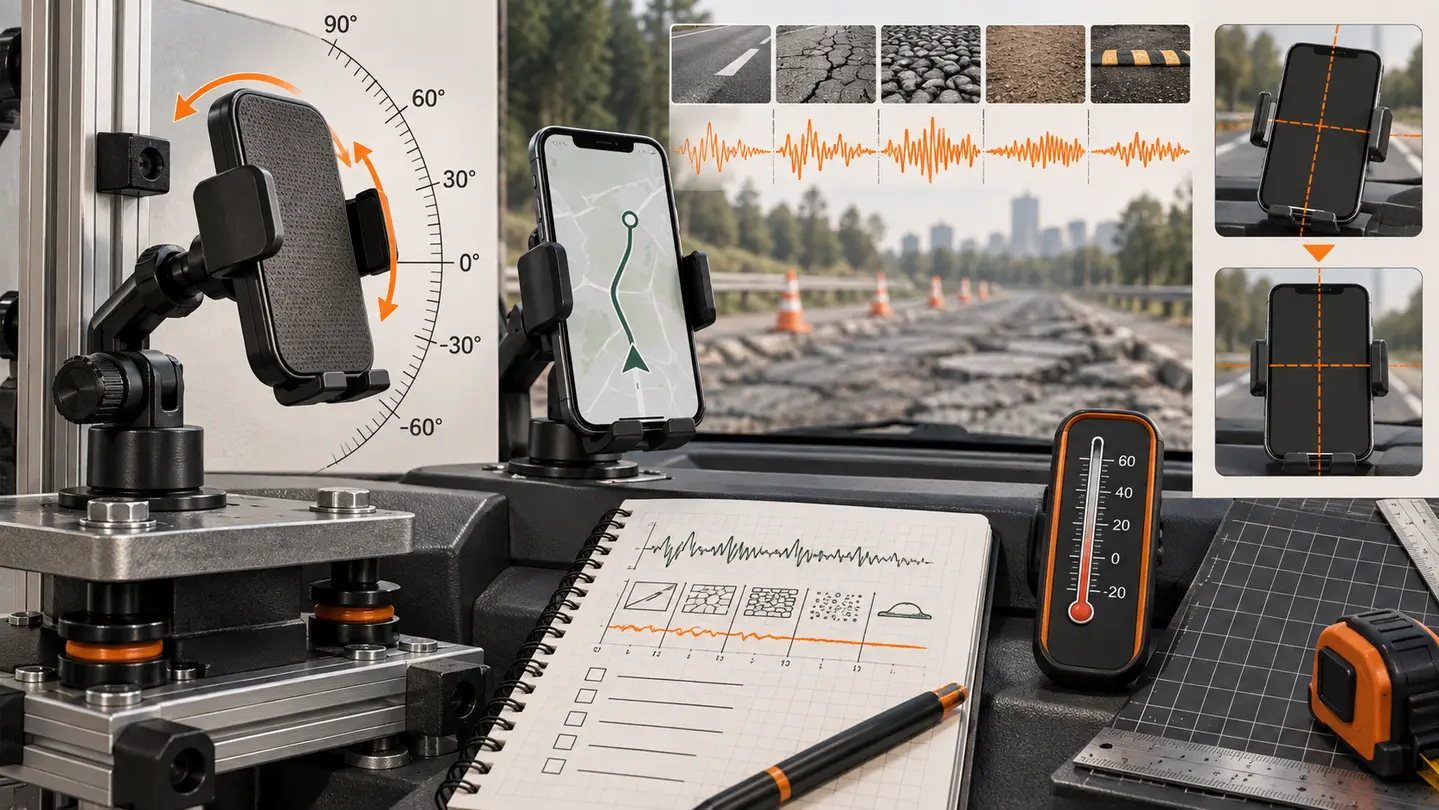
Why each test variable changes the result
Mount results are highly configuration-specific. Phone mass creates leverage, arm extension amplifies movement, vent geometry changes clamp behavior, and temperature can affect adhesives and joint friction.
Use fixed reference marks
Photograph the phone outline and joint positions from the same camera location before and after every run. A visual reference makes gradual drift observable instead of relying on memory.
Record interventions as failures
Tightening a knob, reseating suction, or correcting the view during a run is part of the result. The clock and route continue; a convenient adjustment cannot erase lost stability.
Report transfer limits
A windshield result does not establish performance on textured dashboards, and one vent does not represent another. Conclusions must name the tested vehicle, surface, phone, case, cable, and temperature range.
If two mounts complete the route but one needs two parked readjustments, raw retention alone would hide a meaningful workflow difference.
Reader decision guide
| Question | What a useful answer includes |
|---|---|
| What stays constant? | Vehicle, location, phone mass, case, cable state, arm extension, orientation, route segments, repetitions, and temperature range. |
| What counts as a failure? | Release, base separation, unsafe obstruction, material drift, vent damage, cable interference, or any required intervention. |
| How is drift measured? | Use fixed camera positions and reference marks before and after each segment rather than subjective impressions. |
| How are limits reported? | Results apply only to the disclosed configuration; another dashboard, vent, phone, case, climate, or installation is untested. |
Common mistakes
- Tightening a product during the run and omitting the intervention from results.
- Comparing candidates on different routes or with different arm extensions.
- Averaging convenience with a retention failure until the failure disappears inside a score.
Questions drivers ask
Why use three repetitions?
Repetition helps reveal inconsistent drift or retention; it does not guarantee long-term durability.
Do rough-road tests require aggressive driving?
No. Use lawful normal driving or controlled inputs and disclose them; testing should not create road hazards.
Can one successful day establish durability?
No. Long-term adhesive, joint, and material behavior needs separate aging and environmental evidence.
Sources and evidence notes
NHTSA — Distracted DrivingEstablishes that navigation-system and phone interaction can divert attention and that driving requires full attention.DoorDash — Delivery Driver Gear GuideCurrent platform context for phone mounting, charging, and applicable local laws.Uber — Delivery Gear IdeasDescribes phone mounts as a driver-reported aid while emphasizing hands and eyes on the driving task.Found an error or outdated requirement? See our editorial and corrections policy.