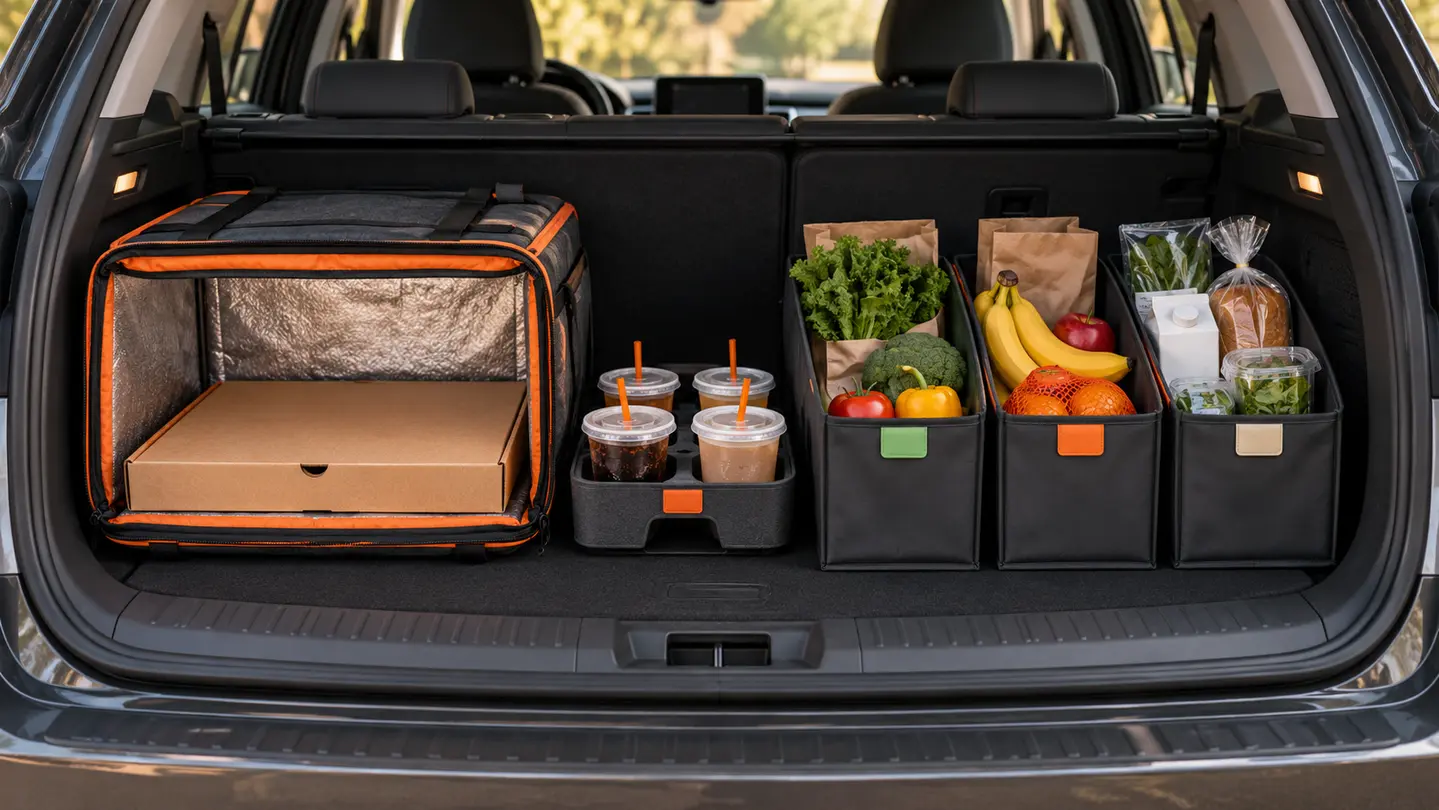
Give each order a stable, identifiable zone that respects temperature, fragility, leaks, and the sequence of stops.
By GigStriker Editorial TeamPublished September 6, 2026Updated September 6, 2026
Evidence label: Research synthesisThis page does not contain product rankings or hands-on performance claims.
A good trunk setup makes the correct order easy to identify without relying on memory. It also prevents rolling containers, crushed bread, leaking cleaners, and hot-cold contact. Begin with the vehicle and the orders you actually accept.
Measure the cargo area
Measure usable width, depth, and height with the hatch closed. Note wheel wells, sloped seatbacks, cargo hooks, access to the spare tire, and the narrowest loading opening. Do not block safety equipment or exceed the vehicle’s load limits.
Assign zones by order and handling need
Zone
Purpose
Rule
Order A / B / C
Prevent customer mix-ups
One visible label or repeated position per order
Cold or frozen
Separate temperature-sensitive items
Closed insulated container; no unsupported time claim
Fragile
Protect eggs, bread, produce, and soft packaging
No heavy items above or against it
Leak risk
Contain upright liquids and cleaners
Follow store packaging; separate from food where appropriate
Returns / personal
Keep non-order items distinct
Never share the active order zone
Use clean, stable bins or structured bags that fit the trunk and can be secured. A very large organizer may reduce flexibility or tempt overloading. Dividers must not collapse into packages during turns or braking.
Load for the route without burying exceptions
Confirm the app’s order identity before placing each load. Use a visible, reusable marker that does not touch or alter sealed goods. Put heavy stable items low, protect fragile items, and keep each customer’s goods together. The next stop should be accessible, but stop order must not override safe load placement.
Reset between runs
Remove receipts, packaging debris, moisture, and personal items. Clean spills according to the container and vehicle instructions. Inspect bins, straps, liners, and labels for damage or residue before the next order.
Multi-order trunk check
Every order has one clearly identifiable zone.
Heavy, fragile, cold, and leak-risk items are handled separately.
Bins and bags fit the measured cargo area with the hatch closed.
Nothing blocks emergency equipment or enters the driver area.
The load is restrained from sliding or tipping.
The trunk is reset and inspected between runs.
Evidence boundary
This workflow does not rank organizers or prove time savings, spill prevention, temperature retention, or crash protection. Those outcomes require controlled loads, routes, maneuvers, timing, and measurement.
Instructional illustration. Multi-order organization combines stable containment with visible identity and handling zones. Digitally created and reviewed by the GigStriker Editorial Team; it is not a product test or proof of performance.
Design for error resistance, not maximum capacity
Multi-order work creates identity, sequence, temperature, fragility, and contamination risks. A good trunk layout makes the wrong action harder even when several bags look identical.
Use redundant order cues
Combine a consistent zone with a visible reusable marker and an app check. Never mark or alter customer packaging in a way that creates confusion, damage, or privacy exposure.
Load by physical risk
Place dense stable items low, prevent bottles from rolling, keep crushable goods above pressure, and isolate cleaners or active leaks according to merchant and platform instructions.
Preserve unloading access
The next stop should be reachable without climbing into the cargo area or moving another order. If route order changes, park and deliberately reset the zones before continuing.
Apply it to a shift
Three full bins are not a successful setup if the rear bin can only be removed after lifting another customer’s groceries onto the pavement.
Affiliate disclosure: This section contains Amazon affiliate links. As an Amazon Associate I earn from qualifying purchases.
SPECIFICATION-VERIFIED CANDIDATES
Products worth checking for fit—not untested winners
These are research candidates selected because the manufacturer publishes relevant specifications. Inclusion is not a ranking, endorsement, or hands-on performance claim.
FORTEM Original Trunk Organizer Large (50L)
Why it made the shortlist: FORTEM documents reinforced base plates, up to three compartments, side pockets, non-slip strips, adjustable securing straps, and a collapsible configuration. The Amazon listing identifies the black 50-liter version as 20.49 × 14.5 × 10.51 inches, giving drivers concrete dimensions to compare with their cargo area and order zones.
Verify before buying: Measure the trunk opening and usable floor space, identify compatible anchor points, and test the organizer empty before loading orders. Dividers and straps do not establish crash restraint, spill containment, temperature control, cleanability, or safe capacity. GigStriker has not independently tested sliding, tipping, handle strength, seam durability, or loaded performance.