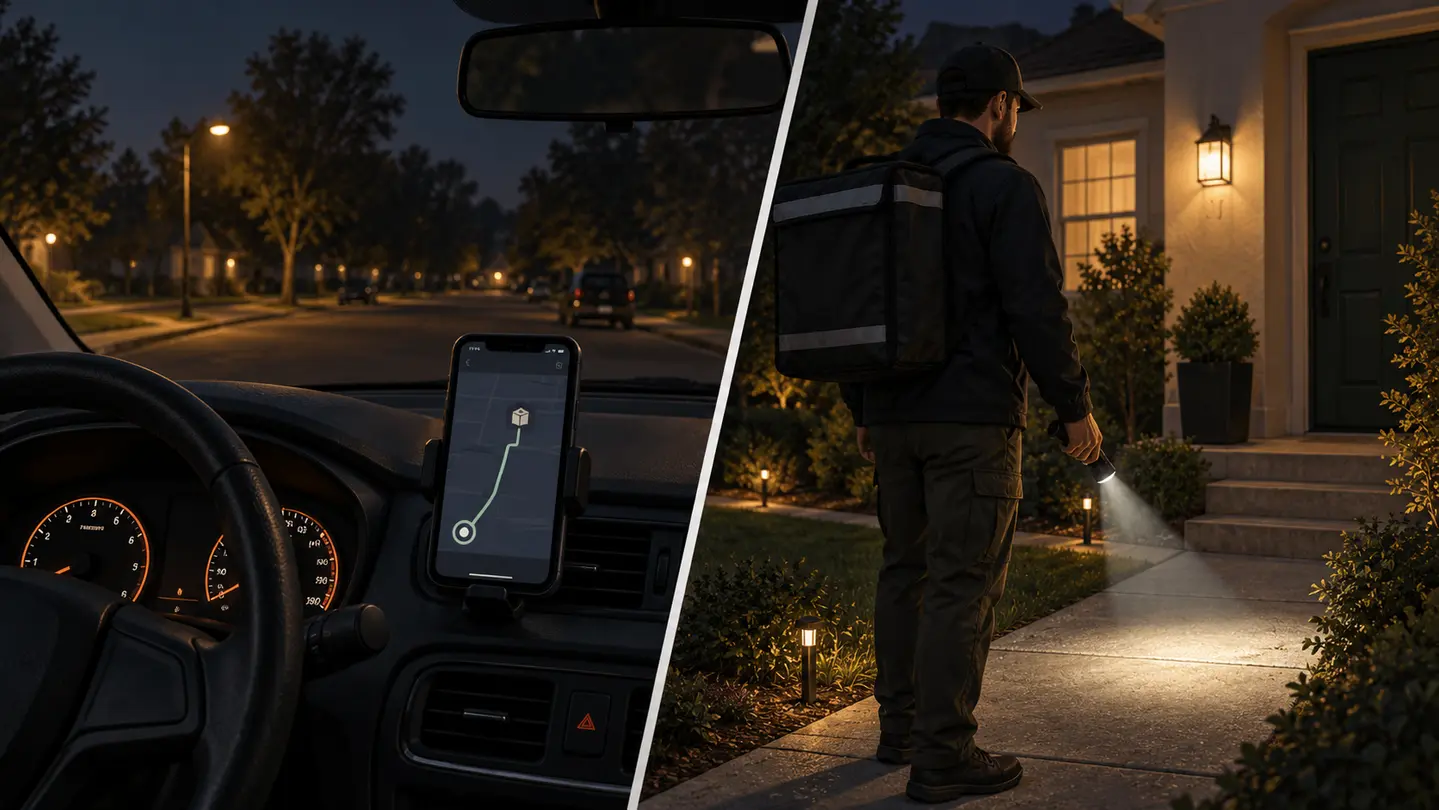
Night delivery setup: seeing addresses without creating glare
Build a parked-and-walking visibility routine that helps identify the stop without flooding the windshield, mirrors, neighbors, or other road users with light.
By GigStriker Editorial TeamPublished September 6, 2026Updated September 6, 2026
Evidence label: Research synthesisThis page does not contain product rankings or hands-on performance claims.
Night delivery combines two different tasks: driving safely to the block and locating the correct entrance after parking. Treat them separately. A light useful on a walkway can create reflections or distraction when used inside a moving vehicle.
Prepare the stop before moving
Review the address, delivery notes, building name, entrance side, and safe parking options before leaving the pickup point. Use voice guidance where practical. Do not type, zoom, or sweep a flashlight across properties while driving; pull over legally if the destination remains unclear.
Control light inside the vehicle
Source
Check while parked
Failure to avoid
Phone
Readable brightness and secure position
Bright screen reflected in glass
Cabin lamp
Easy off control
Reduced view beyond the windshield
Flashlight
Stored securely until parked
Rolling object or accidental activation
Reflective gear
Visible without restricting movement
False confidence around traffic
Keep glass and mirrors clean because haze and fingerprints can scatter light. Never cover warning displays or alter required vehicle lighting to reduce glare.
Use a deliberate address-search pattern
After parking safely, confirm the street and house-number sequence in the app. Look for curb numbers, mailbox numbers, porch markings, unit ranges, and building signs. Use only enough directed light to read the target area. Avoid aiming into windows, at faces, toward traffic, or across a driver’s line of sight.
On foot, illuminate the near walking surface before the distant address. Uneven pavement, steps, hoses, toys, pets, and landscaping can be the more immediate hazard.
Night-shift setup
Route and delivery notes reviewed while parked.
Phone brightness is readable without obvious windshield reflection.
Flashlight is charged, secured, and reachable after parking.
Reflective or visible outer layer does not restrict movement.
Address-confirmation routine avoids photographing or disturbing neighbors.
Unclear stops are resolved from a safe lawful parking position.
Evidence boundary
This guide synthesizes safety and platform guidance. It does not prove that a specific beam, lumen rating, tint, or wearable improves delivery safety. Those claims require a disclosed nighttime protocol, viewing distances, ambient light, target types, battery state, and glare observations.
Instructional illustration. Separate navigation, address confirmation, and walkway lighting into parked-first tasks. Digitally created and reviewed by the GigStriker Editorial Team; it is not a product test or proof of performance.
Protect dark adaptation and reduce search time
The goal is not maximum brightness. It is enough information to confirm the correct property and walk safely while avoiding reflections, dazzled vision, and unnecessary light into homes or traffic.
Use number patterns before extra light
Observe whether odd and even addresses occupy different sides and how numbers progress along the block. This narrows the search area before any flashlight is used.
Aim from near to far
After parking, check the ground, curb, and steps first, then briefly direct light toward likely number locations. Avoid sweeping across windows, people, moving vehicles, or neighboring properties.
Recover from uncertainty safely
If the address cannot be confirmed, return to a safe position, review notes, contact the customer through approved channels, or follow platform procedures. Do not wander into unmarked side yards.
Apply it to a shift
A brighter beam can make reflective signs easy to read while simultaneously destroying detail in nearby shadows; controllable low modes matter.
Affiliate disclosure: This section contains Amazon affiliate links. As an Amazon Associate I earn from qualifying purchases.
SPECIFICATION-VERIFIED CANDIDATES
Products worth checking for fit—not untested winners
These are research candidates selected because the manufacturer publishes relevant specifications. Inclusion is not a ranking, endorsement, or hands-on performance claim.
Streamlight ProTac 1L-1AA (88061)
Why it made the shortlist: Streamlight documents both CR123A and AA battery compatibility, selectable output modes, an anti-roll head, pocket clip, IPX7 water resistance, and tested impact resistance. Its documented low and high modes make it a useful candidate for the guide’s address-reading, carry, battery, and glare-control checks.
Verify before buying: Use a light only while lawfully parked or standing in a safe location, avoid shining it toward drivers, residents, windows, or cameras, and select the lowest useful output. Confirm local rules and battery condition. GigStriker has not independently tested beam suitability, runtime, water resistance, impact resistance, or long-term durability.