Flashlight features that matter for delivery drivers
Select for controlled light, dependable access, and the length of the walking task—not the largest output number.
By GigStriker Editorial TeamPublished September 6, 2026Updated September 6, 2026
Evidence label: Research synthesisThis page does not contain product rankings or hands-on performance claims.
A delivery flashlight has two main jobs: reveal a nearby walking surface and briefly identify an address farther away. Maximum output alone says little about either task. Beam shape, low modes, controls, runtime, storage, and weather resistance can matter more.
Translate the job into features
Work need
Feature to inspect
Specification limit
Read a distant number
Focused center beam and aim control
Output alone does not describe reach
See steps and paths
Even nearby spill and usable low mode
Very bright light can wash out close detail
Work in rain
Documented ingress rating and sealed ports
A rating must match its stated test conditions
Repeated short stops
Simple switch and predictable mode order
More modes are not automatically useful
Finish a long shift
Runtime at the mode you will use
Turbo runtime may be brief or thermally limited
Prefer control over excess light
A low or medium mode can be more appropriate around doors, reflective signs, windows, and people. Check whether the light remembers the last setting or always starts in a particular mode. A recessed or lockable switch can reduce accidental activation in a pocket or vehicle bin.
Evaluate the power plan
Read runtime by output level, not a single headline number. Decide whether replaceable cells or internal charging fit your shift. If it charges in the car, include it in the power budget and secure both light and cable. Follow the maker’s battery and charging instructions; do not mix damaged or incompatible cells.
Fit the carry method
The light should remain secured while driving and be retrievable after parking. Check body diameter, clip orientation, lanyard attachment, glove use, and whether a magnetic base could affect cards or electronics. A headlamp keeps hands free but must be easy to dim and redirect away from faces.
Specification worksheet
Low and medium modes suit close walking tasks.
Beam can be aimed without excessive spill into windows or traffic.
Runtime is stated for the intended mode.
Controls are predictable with one hand or gloves.
Ingress claim and charging-port cover are documented.
Light has a secure vehicle and walking carry position.
Evidence boundary
GigStriker has not ranked flashlights or verified beam distance, sustained output, impact survival, runtime, or water resistance. A comparison must use the same batteries, modes, distances, targets, ambient light, temperature, and measurement interval.
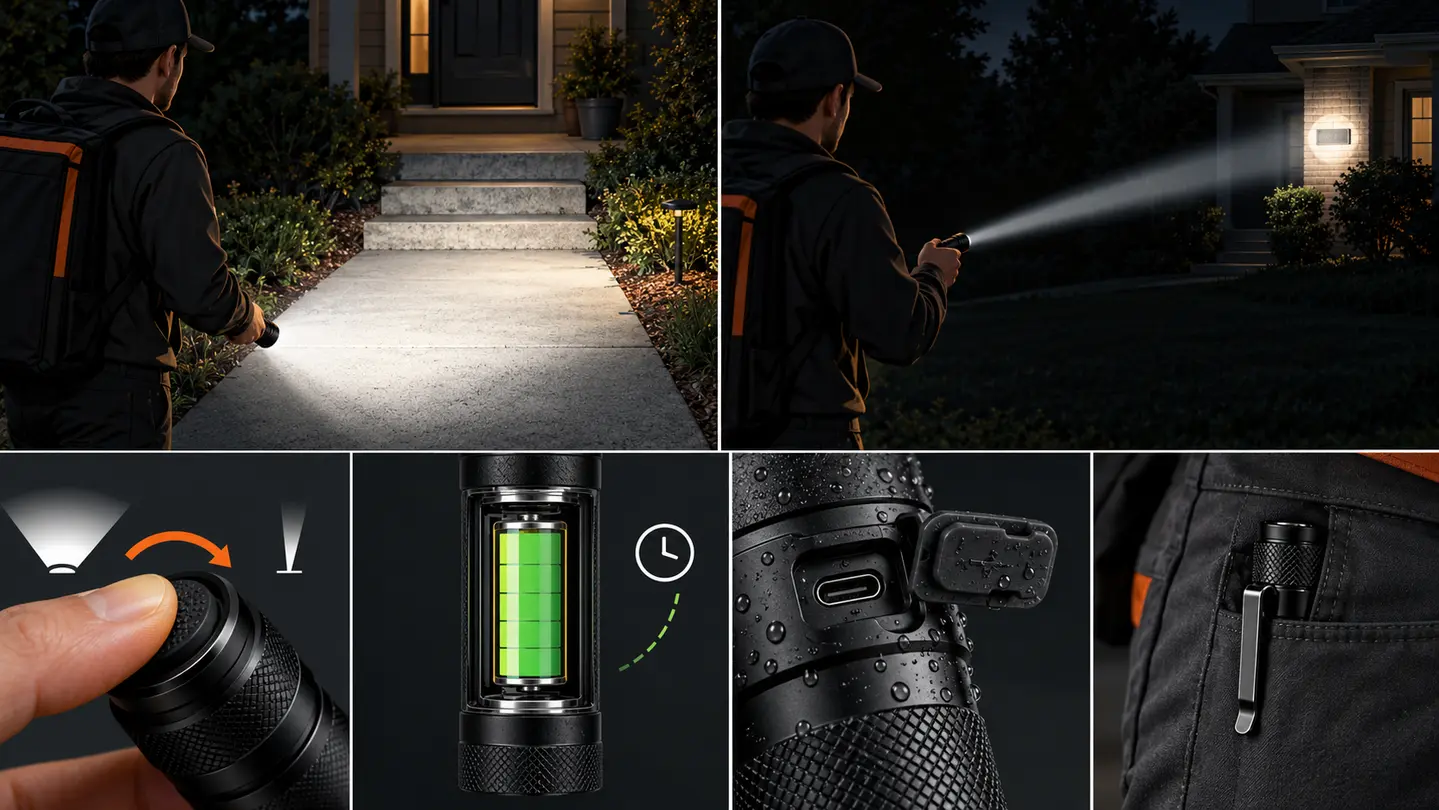
Instructional illustration. Beam control, usable modes, runtime, interface, and carry fit matter more than maximum output alone. Digitally created and reviewed by the GigStriker Editorial Team; it is not a product test or proof of performance.
Read specifications as operating tradeoffs
Output, beam intensity, runtime, temperature, and battery capacity interact. A light may advertise extreme output that steps down quickly, while a lower mode may provide the useful balance for repeated short stops.
Distinguish flood from reach
A broad beam helps with nearby footing; a concentrated center helps identify distant numbers. Delivery work often benefits from both, but beam photographs under disclosed settings are more informative than a lumen number alone.
Study the user interface
Mode order, memory, lockout, switch location, and feedback determine whether the right level can be reached quickly. Hidden multi-click commands add friction when hands are occupied or gloves are worn.
Plan charging and redundancy
A rechargeable light should enter the shift with documented reserve. A modest backup light can address a dead battery more reliably than assuming one high-output device will always be available.
Apply it to a shift
For a ten-second walkway task repeated twenty times, accessible low and medium modes may be more valuable than a short-lived maximum mode.
Affiliate disclosure: This section contains Amazon affiliate links. As an Amazon Associate I earn from qualifying purchases.
SPECIFICATION-VERIFIED CANDIDATES
Products worth checking for fit—not untested winners
These are research candidates selected because the manufacturer publishes relevant specifications. Inclusion is not a ranking, endorsement, or hands-on performance claim.
Streamlight ProTac 1L-1AA (88061)
Why it made the shortlist: Streamlight documents both CR123A and AA battery compatibility, multiple output modes, an anti-roll head, pocket clip, IPX7 water resistance, and tested impact resistance. Those published characteristics make it a practical candidate for the guide’s battery, carry, weather, and accidental-drop checks.
Verify before buying: Confirm the permitted battery types, preferred operating mode, carry position, local use rules, and whether the beam pattern works for address reading without creating glare. GigStriker has not independently tested runtime, water resistance, impact resistance, controls, or long-term durability.